
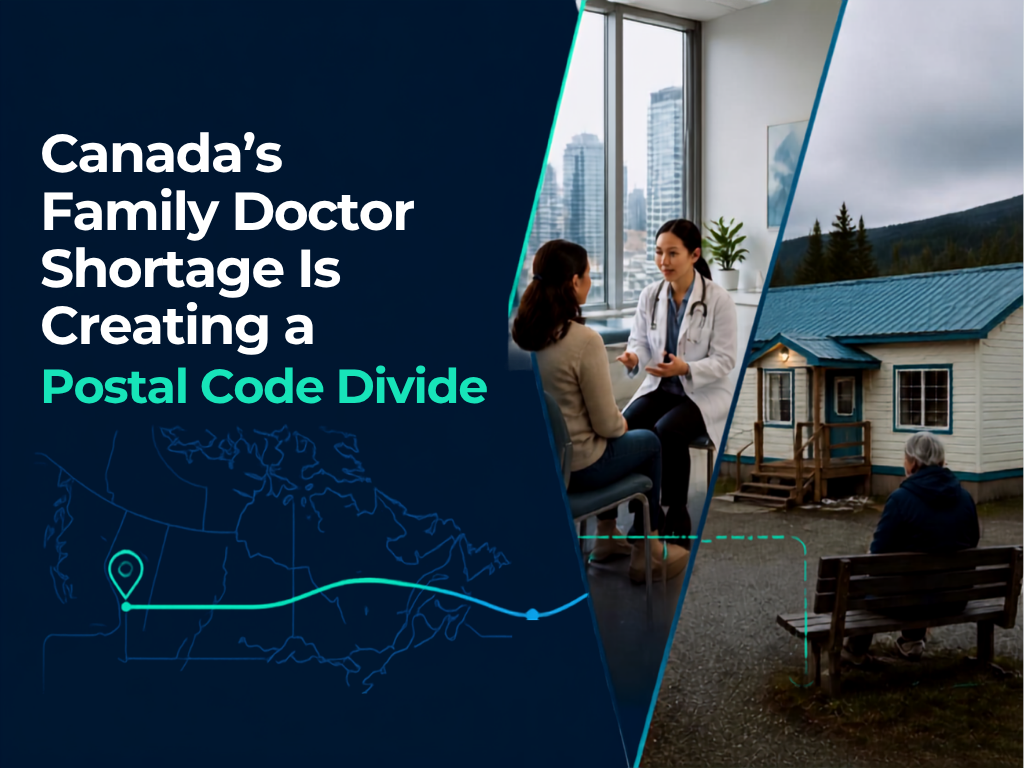
Family Doctor Shortage in Canada: Why Your Postal Code Matters
 Carmelia Ray
| Family Doctor Shortage in Canada: The Provincial Divide |
5.9 million Canadians don’t have a family doctor. Whether you’re one of them depends heavily on your province.
Canada’s healthcare system is built on a simple promise: your care shouldn’t depend on where you live or what you can afford. In practice, for millions of Canadians, it already does, and the gap is widening.
An estimated 5.9 million adults in Canada currently lack reliable access to a family doctor, nurse practitioner, or primary care team. Over the past decade, the share of Canadians reporting difficult or no access to primary care has climbed by roughly 25%. That’s not a rounding error. That’s a system losing ground.
The map isn’t even close to flat
Averages hide the real story. In Saskatchewan, about 63% of residents either have no family doctor or are struggling to access one, the worst rate in the country. In Ontario, projections suggest that by 2026, roughly one in four residents, about 4.4 million people, will be without a family doctor, with nearly a million of those in Toronto alone. Atlantic Canada and Quebec are also among the toughest places in the country to find consistent primary care.
Two Canadians in two provinces, paying into the same universal system, can have completely different realities: one books a same-week appointment with a doctor they’ve seen for years; the other has been on a waitlist so long they’ve stopped counting and now treats the walk-in clinic as their default option.
Why the gap is growing
Part of the answer is simple demographics: an aging population needs more care from a workforce that isn’t growing fast enough to match it. Part of it is the mix of physicians we’re training: more specialists relative to family doctors, when it’s family doctors who form the front door of the system. And part of it is retention: in Ontario alone, 52% of family physicians say they’re considering retirement within the next five years. Every one of those retirements removes a doctor from a system that’s already short-staffed and doesn’t automatically produce a replacement.
It’s worth saying plainly: this isn’t a story about doctors not caring enough or not working hard enough. Most family physicians in this country are stretched well past a sustainable caseload already. This is a story about a system that hasn’t built the pipeline, the incentives, or the support structures to keep pace with the country it serves.
The fixes that are already working
The good news is that we don’t have to invent solutions from scratch; some provinces are already proving what works. British Columbia added more than 1,000 family doctors and tripled its supply of primary-care nurse practitioners since 2017 and, in 2024, matched a record 250,000 people to a primary care provider through its Health Connect Registry. Team-based models where nurse practitioners, pharmacists, and family doctors work together, and patients see whichever provider is right for their needs, are showing real results in cutting both wait times and emergency room visits.
The fix isn’t mysterious. It’s expanding the primary care workforce with the providers we already know work: family doctors, yes, but also nurse practitioners, pharmacists, and midwives operating to the full scope of their training and making sure every province, not just the well-resourced ones, has the funding and structure to build it.
A postal code should not decide a Canadian’s care. Join Common Sense Healthcare Canada and help build the pressure to close the gap, province by province.
Sources: Canadian Medical Association national primary care survey; Angus Reid Institute, “Health Care Access in Canada, 2026”; Ontario College of Family Physicians workforce projections.