
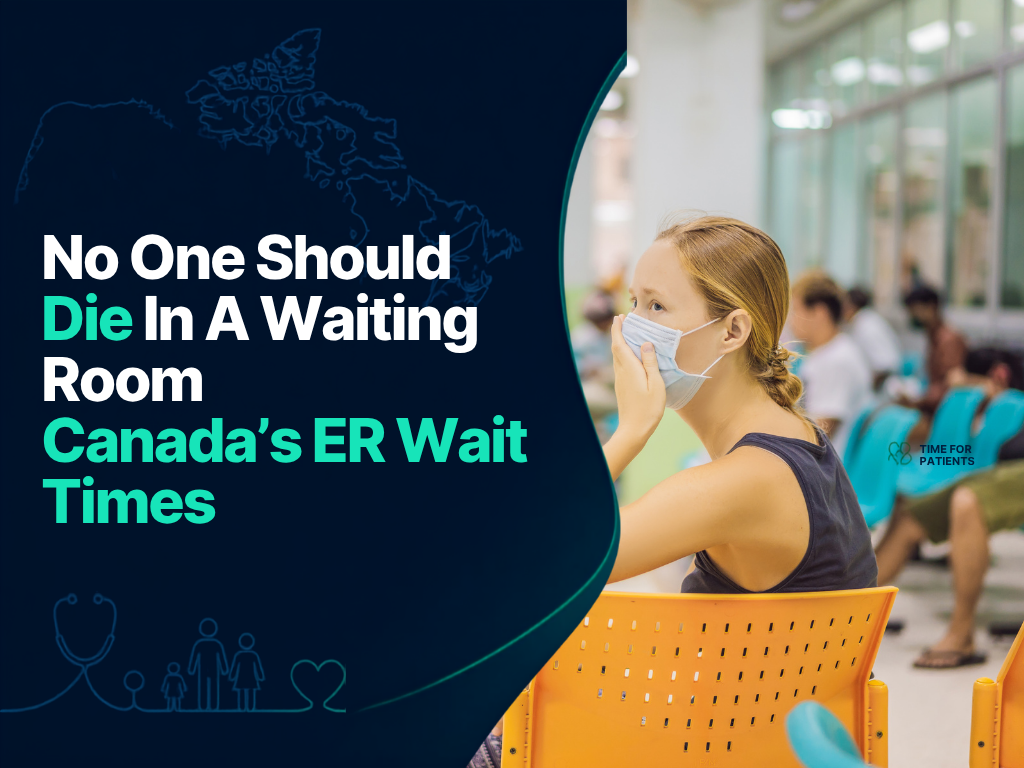
No One Should Die in a Waiting Room: Canada’s ER Wait Time Crisis
 Carmelia Ray
1 in 10 Canadians admitted to hospital last year waited more than 48 hours for a bed. Behind that number are families who lost people they loved.
There is a number that should stop anyone in their tracks: 1 in 10 Canadians admitted to hospital in the past year waited more than 48 hours in the emergency room before they had a bed. Roughly 1.5 million people waited more than 14 hours. These aren’t patients being triaged for minor issues. They are people sick enough to be admitted, spending two full days in a hallway or a waiting room before the system could catch up to their need.
The human cost behind the statistic
Numbers like these can start to feel abstract, so it matters to say plainly: people have died waiting. In Edmonton in December 2025, Prashanth Sreekumar, a 44-year-old father and accountant, collapsed and died after waiting more than eight hours with chest pain. In May 2026, Travis Smith, 33, died in the waiting room of Edmonton’s Royal Alexandra Hospital. Around the same period, an ER physician in Alberta documented six deaths and roughly 30 critical near-misses in that province’s emergency rooms over the span of just two weeks. Alberta’s own doctors have called for a declared state of emergency over ER overcrowding.
These stories are shared here with care, not to shock, but because refusing to look away is the first step toward change. Every family behind these numbers deserved a system that could catch them in time.
This is not a story about frontline staff failing
It bears repeating clearly: the nurses, doctors, and paramedics working these shifts are not the cause of this crisis. They are, in most cases, the last line of defence against it working past capacity, in hallways turned into treatment spaces, trying to hold together a system that has been stretched well beyond what it was designed to handle. The failure here belongs to the system around them: too few inpatient beds, discharge and long-term care bottlenecks that leave hospital beds occupied by patients who are medically ready to leave but have nowhere to go, and a primary care shortage that pushes people into the ER for problems that never should have reached that point.
What actually relieves the pressure
Emergency rooms back up for a chain of reasons, which means the fix has to work on more than one link in that chain at once. Expanding access to family doctors, nurse practitioners, and team-based primary care keeps people with non-emergency needs out of the ER in the first place — evidence already shows this works, from library-based nurse-practitioner clinics to rural sites where adding a nurse prescriber redirected roughly a quarter of less-urgent patients away from emergency care. Addressing the discharge bottleneck — making sure patients who are ready to leave hospital have somewhere safe to go frees up the inpatient beds that are the actual constraint behind the 48-hour wait. And protecting the healthcare workforce from burnout and unsafe conditions keeps the people running the system from leaving it altogether.
None of this requires abandoning what Canadians value about universal care. It requires treating a documented, repeated pattern of deaths in Canadian waiting rooms as the emergency it is, and building the capacity to make sure it stops being normal.
If you or someone you love has a wait-time story, we want to hear it your story becomes part of the evidence that drives change. Join Common Sense Healthcare Canada.
Sources: CIHI emergency department wait time reporting, via CBC News and Global News; Yahoo News Canada and CBC News reporting on Alberta ER deaths; Alberta Politics reporting on documented ER near-misses, January 2026.