
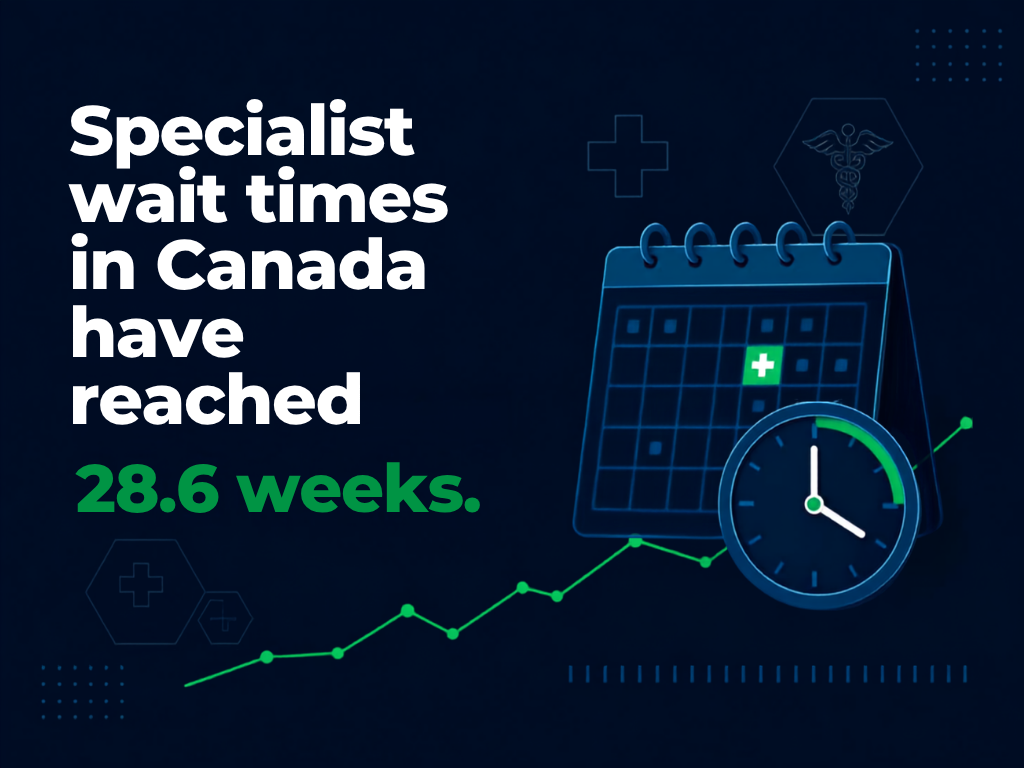
Specialist wait times in Canada have reached 28.6 weeks. See which specialties have the longest waits, what delays cost Canadians, and what can fix them.
-
by
Common Sense Healthcare TeamMember
- No Comments on Specialist wait times in Canada have reached 28.6 weeks. See which specialties have the longest waits, what delays cost Canadians, and what can fix them.
How Long Is the Wait for a Specialist in Canada, Really?
The median wait from referral to treatment is 28.6 weeks. Here’s what that number actually costs us.
If you’ve ever been referred to a specialist in Canada and then sat down to actually count the weeks, you already know the punchline: it takes a long time. What most of us don’t know is exactly how long and how that number has moved over the past three decades.
The answer, as of the most recent measurement, is 28.6 weeks. That’s the median wait between the day a family doctor refers a patient to a specialist and the day that patient actually receives treatment: nearly seven months. It’s the second-longest wait ever recorded in Canada, just slightly better than 2024’s 30 weeks, and more than three times longer than the same wait was in 1993.
Where the wait is worst
The overall number hides a lot of variation. Some specialties are managing the crunch better than others. The longest waits right now are in neurosurgery, at just under 50 weeks, and orthopedic surgery, at roughly 48.6 weeks. If you need a hip replaced or a herniated disc addressed, in other words, you could be looking at close to a year between referral and treatment.
These aren’t abstractions. A 49-week wait for neurosurgery means chronic pain, lost mobility, and lost work, month after month, for people who are often told the problem is manageable and just needs to be watched. “Watching” a treatable condition for a year is not a plan. It’s a queue.
The price tag no one talks about
Long waits are usually framed as a quality-of-life problem, and they are. But they’re also an economic one. Research published in early 2026 estimated that Canadians lost $4.2 billion in wages and productivity last year simply waiting for care, time off work, reduced hours, and lost income while sitting on a waitlist for treatment that would have let them function normally.
That reframes the conversation in a useful way. Fixing wait times isn’t a cost we’re being asked to absorb out of compassion. It’s an investment that pays for itself many times over in the wages, tax revenue, and productivity that get returned to the economy the moment people can get back to their lives.
Why this keeps happening
There’s no single villain here. It’s a mix of a growing and aging population; a slower pipeline of new specialists relative to demand; and administrative bottlenecks, referral systems, scheduling backlogs, and duplicated paperwork that add weeks to a process that should take days. None of this is the fault of the doctors and surgeons doing the work. Most specialists in this country are already operating at capacity; the system around them hasn’t kept pace with what they’re being asked to handle.
What a fix actually looks like
Faster access doesn’t require dismantling anything Canadians value about their healthcare system. It requires the less glamorous work of expanding capacity where the bottlenecks actually are more residency and training seats in the specialties with the longest queues, centralized referral and booking systems that route patients to the next available qualified specialist instead of the specific one they happened to be sent to; and better use of nurse practitioners and other team-based care to handle what doesn’t need a specialist in the first place, freeing up capacity for what does.
None of that is radical. It’s common sense, and it’s the kind of fix that keeps a universal system universal by making sure it can actually deliver on the promise.
Common Sense Healthcare Canada is building the case, and the pressure, for faster specialist access without abandoning universal care. Join the movement to add your voice.
Sources: Canadian Institute for Health Information (CIHI) wait time data, reported by CTV News and the Globe and Mail; Fraser Institute wait time cost analysis, March 2026, reported by Global News and Medscape.